
Beginners Program
A year-round introduction to rhythmic gymnastics. Learn body technique, all five apparatus, ballet basics, and build the flexibility and strength that define the sport.
Your First Steps in the Sport
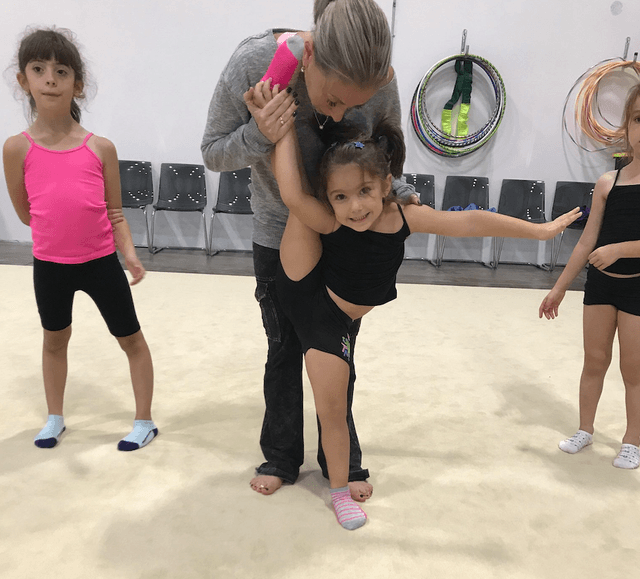
Our Beginners Program is designed for children aged 5 and up with no prior gymnastics experience. Classes run year-round, once or twice weekly, with each session lasting 90 minutes - enough time to warm up, train, and cool down properly.
You do not need to be flexible, strong, or coordinated to start. Every competitive rhythmic gymnast began as a beginner who could not yet do the things they learned to do. Flexibility, strength, balance, and musicality are all outcomes of training, not prerequisites.
All sessions are led by experienced and certified rhythmic gymnastics coaches who build technique carefully and progressively, ensuring each gymnast develops a solid foundation before advancing.
Inside a 90-Minute Session
Every session balances technique, strength, creativity, and fun. Here is how the time breaks down.
Warm-Up & Jump Rope
Classes open with jump rope, light jogging, or trampoline activities. This gets the heart rate up and introduces basic coordination and rhythm in a fun, accessible way.
Ballet Barre & Stretching
A ballet-based warm-up focused on the five basic foot positions, arm positions, posture, and body alignment. Flexibility work - splits, backbends, shoulder and hip mobility - is woven throughout.
Body Element Training
Foundational body difficulties: basic balances (releve, passe), simple pivots and turns, small jumps and leaps. This is where gymnasts build the core technique that underpins everything in the sport.
Apparatus Introduction
Hands-on work with one or two apparatus per session. Beginners use lightweight, age-appropriate equipment and focus on basic handling: rolling, swinging, tossing, and catching.
Partner Conditioning
Strength-building exercises done in pairs - sit-ups, back exercises, sprints. Builds the core and leg strength needed for gymnastics while fostering teamwork and social bonding.
Routine Choreography
When a performance or showcase is approaching, the final segment is devoted to routine practice. Otherwise, this time goes to additional apparatus work or cool-down stretching.
The Five Apparatus
Rhythmic gymnastics uses five handheld apparatus. Beginners are introduced to them progressively, starting with the most accessible and building toward the most complex.
Ball
Most beginner-friendly18-20 cm diameter, soft pliable rubber. Beginners learn to roll the ball across hands, arms, and body surfaces, plus controlled bouncing and simple tosses. The ball's natural rolling motion makes it the most intuitive apparatus to start with.
Rope
FoundationalLength varies by gymnast height. Used for jumping and skipping (like jump rope), simple swings, wraps, and basic tosses. Builds rhythm, timing, and cardiovascular endurance - the heartbeat of rhythmic gymnastics training.
Hoop
Intermediate70-80 cm diameter for juniors. Beginners practice rolling on the floor, rolling along the body, passing through the hoop, and basic rotations around the hand. The circular shape makes rolling intuitive and visually rewarding.
Ribbon
Advanced4 meters for juniors, attached to a short stick. The ribbon must stay in constant motion and never touch the floor. Beginners start with shorter ribbons and focus on big, simple shapes - arcs, circles, and spirals - before adding body movement.
Clubs
Most complexAbout 40 cm long, used in pairs. Beginners start with single-club handling (circles, swings) before progressing to two-club coordination. Introduced last because managing two objects simultaneously requires fine motor skills that develop over time.
Body Technique
Beyond apparatus, rhythmic gymnastics requires mastery of body difficulties - the balances, turns, jumps, and flexibility elements that make up a routine.
Balances
Standing positions held on one leg for at least one second. Beginners progress from flat-foot balances to releve (on toes).
- Releve balance (standing tall on toes with one leg raised)
- Passe balance (one foot at the knee of the standing leg)
- Front scale / arabesque (leg extended behind)
Pivots (Turns)
Balances that rotate - a gymnast must maintain position while turning a minimum of 360 degrees.
- Passe pivot (360-degree turn with foot at the knee)
- Chaine turns (rapid traveling half-turns)
- Quarter and half turns as stepping stones to full rotations
Jumps & Leaps
Leaps take off from one foot and land on the other. Jumps take off and land on both or one foot.
- Straight jump (vertical jump with pointed toes)
- Tuck jump (knees pulled to chest mid-air)
- Split leap preparation (building toward a full split in the air)
- Sissonne (a ballet-derived split jump from two feet)
Flexibility
With consistent training, most beginners can achieve full splits within a few months.
- Forward and side splits
- Bridge / backbend
- Basic back flexibility and arch positions
- Shoulder flexibility exercises
From First Class to First Competition
There is no fixed timeline - consistent weekly attendance matters more than intensity at the beginner level. Here is the typical progression.
Training: 1-2 classes per week, 90 min each
Basic body positions, introductory apparatus handling, flexibility development, and ballet fundamentals. Informal in-house showcases may be held during this phase.
Training: 2-3 classes per week
Level 3 is the first official USAG competitive level. Gymnasts compete a floor exercise and routines with 1-2 apparatus at local and invitational meets. The focus is on skill development rather than scores.
Training: 3-4 days per week, 2-3 hours per session
Compulsory routines with specific body difficulty requirements. Ballet training becomes required at minimum twice weekly. State and regional championships become available.
What Develops Over Time
The physical traits that define rhythmic gymnasts - extreme flexibility, body control, grace - are outcomes of training, not prerequisites. Here is what to expect.
| Physical Quality | Noticeable Improvement |
|---|---|
| Flexibility (splits, bridges) | Full splits achievable within a few months of consistent stretching |
| Core strength | Steady improvement over first 3-6 months |
| Balance | Rapid improvement in first weeks, continues refining for years |
| Coordination | Noticeable improvement within the first month |
| Arm strength | Develops over 3-6 months with apparatus work |
| Musicality & expression | Emerges over months of ballet and routine practice |
Ready to Start?
No prior gymnastics experience is necessary. Registration is open year-round for children aged 5 and older. Contact us by phone or email to learn about scheduling, fees, and available class times.
Your child's first class is the only thing that separates a curious beginner from a future rhythmic gymnast.
Ready to Get Started?
Join us for a free trial class and experience the joy of rhythmic gymnastics.