"What age should my child start?" is the question we hear most from parents. The short answer: ages 3 to 5 is the ideal window, but it is never too late to begin. The longer answer depends on what your child wants to get out of the sport.
This guide breaks down what to expect at each age, what skills children develop, and how to know when your child is ready.
Ages 3-4: The Ideal Starting Window
This is when flexibility training is most effective. Young children's muscles and connective tissue are naturally more pliable, which means the flexibility gains they make at this age become a lasting foundation that is much harder to build later.
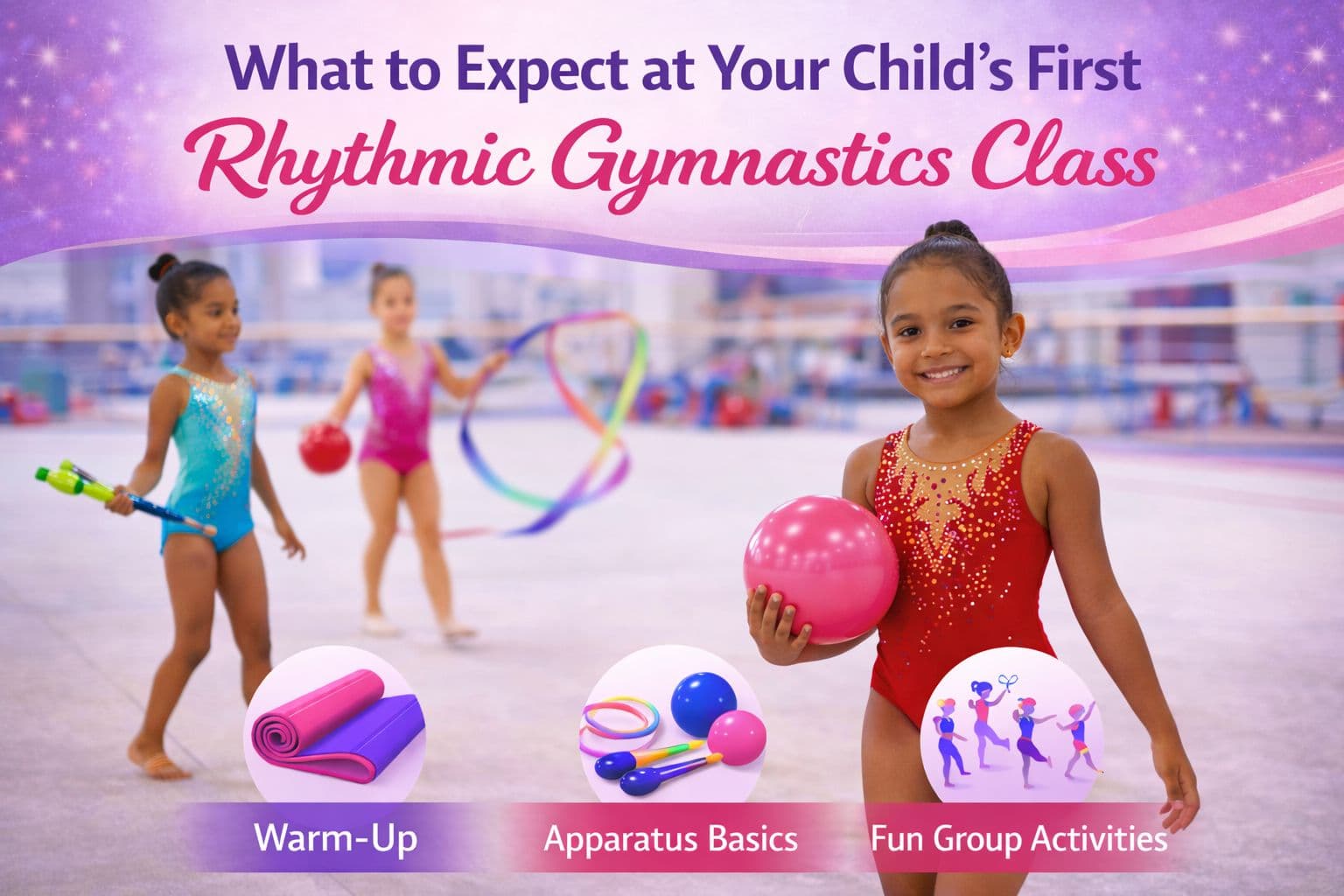
At this age, rhythmic gymnastics is entirely play-based. Children don't sit through drills - they march to music, wave scarves, roll balls, and learn body shapes through games and creative movement. The focus is on coordination, rhythm, listening skills, and falling in love with movement.
Our Preschool Program is designed specifically for this age group. Classes are 45-55 minutes with structured stations, guided stretching, and age-appropriate apparatus like mini balls, short ribbons, and small hoops.
What 3-4 year olds typically learn:
- Basic body shapes (tuck, star, straight)
- Marching, galloping, and skipping to music
- Simple scarf and ribbon waving patterns
- Standing on one foot for a few seconds
- Forward rolls and basic balance activities
- Early splits preparation through playful stretching
Ages 5-7: A Great Time to Begin
Children in this range can handle longer sessions and more structured training. They are old enough to follow multi-step instructions, remember short routines, and work on specific skills with focus.
This is when the real apparatus work begins. Children learn to handle all five competition apparatus - ball, rope, hoop, ribbon, and clubs - and start developing the body technique (balances, turns, jumps) that forms the backbone of the sport.
Our Beginners Program serves ages 5 and up with 90-minute sessions that include warm-up, ballet barre, body element training, apparatus work, conditioning, and choreography.
Flexibility is still very trainable at this age. Most children who start at 5-7 and train consistently can achieve full splits within a few months.
Ages 8-10: Not Too Late
Children who start at 8-10 can absolutely develop into skilled gymnasts. They often progress faster through the early skills because of their greater strength, coordination, and attention span.
The main difference is flexibility. It takes longer to develop at this age compared to a 3-year-old, and it requires more consistent, dedicated stretching. But it is achievable with regular training.
If your child has a background in dance or ballet, they will have a head start on body technique and musicality, which are two of the hardest things to teach.
Ages 11+: Starting Later
Reaching elite competitive levels becomes more difficult when starting after 10-11, simply because the training volume required at higher levels builds on years of foundational work. However, rhythmic gymnastics offers tremendous value for older beginners:
- Flexibility, strength, and body awareness that transfer to every other sport
- Coordination and rhythm skills that improve dance, figure skating, and cheerleading
- Confidence and self-expression through performance
- A lifelong relationship with movement and physical fitness
Our Multi-Sport Flexibility classes are also a great option for older athletes from any sport who want the flexibility and body control benefits without committing to the full rhythmic gymnastics curriculum.
What Happens in a First Class
Knowing what to expect makes the first class easier for both parents and children. Here is what a typical trial class looks like:
- Arrive 10-15 minutes early to complete paperwork and let your child get comfortable with the space
- Children wear a leotard or fitted athletic clothing with hair tied back, white socks, and no jewelry
- Classes open with a warm-up: music, movement, and fun activities to get bodies moving
- Guided stretching follows, with coaches working on age-appropriate flexibility
- The main portion rotates through skill stations or apparatus work
- Classes end with a cool-down and a moment for coaches to share feedback with parents
It is completely normal for younger children to need a few classes before they fully engage. Some prefer to observe before participating, and that is okay.
Signs Your Child Is Ready
There is no strict readiness test, but these are positive indicators:
- They can follow simple instructions from an adult other than their parent
- They show interest in music, dancing, or moving their body
- They can separate from their parent for 45-60 minutes (for preschool) or 90 minutes (for beginners)
- They are curious about ribbons, hoops, balls, or other props
- They watch gymnastics or dance videos and want to try what they see
If your child checks even one or two of these, they are ready to try a class. The rest comes with time.
Ready to Try?
Your child's first class is the only thing that separates curiosity from experience. Book a free trial class at our McKinney or Frisco studio, or contact us with any questions. We are happy to help you find the right program and schedule for your family.